





Allen R. McConnell
- Media Contact
My work explores (1) how nonconscious and conscious feelings and beliefs affect judgment and behavior, (2) how self-knowledge influences emotions, goals, and actions, (3) the psychology of pet ownership, and (4) the impact of group stereotypes and stigma on performance, with this research supported over the years by National Institute of Mental Health and National Science Foundation grants.
My service includes being editor in chief of Social Psychological and Personality Science, associate editor at Journal of Personality and Social Psychology and Journal of Experimental Social Psychology, member of the National Science Foundation social psychology grant panel, and conference organizer for the SPSP Social Cognition Preconference. My recognitions include being named the James and Beth Lewis Endowed Professor, University Distinguished Scholar, and Professor of the Year in Psychology.
In the classroom, I teach courses in social psychology, social cognition, attitudes, nonconscious behavior, the self, judgment and decision making, and intergroup relations at the graduate and undergraduate levels.
Finally, my expertise has been applied to consumer behavior and to legal and trial consulting, and my scholarship has been presented in a number of legal venues including in briefs argued before the U.S. Supreme Court.
Primary Interests:
- Applied Social Psychology
- Attitudes and Beliefs
- Close Relationships
- Emotion, Mood, Affect
- Intergroup Relations
- Judgment and Decision Making
- Life Satisfaction, Well-Being
- Personality, Individual Differences
- Persuasion, Social Influence
- Prejudice and Stereotyping
- Self and Identity
- Social Cognition
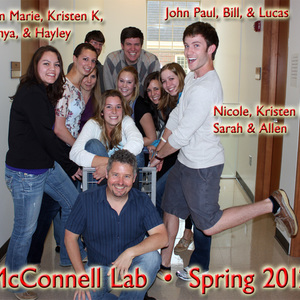
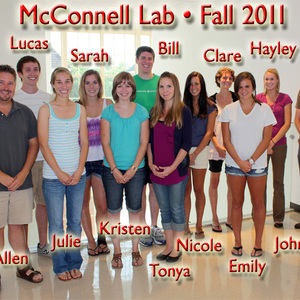
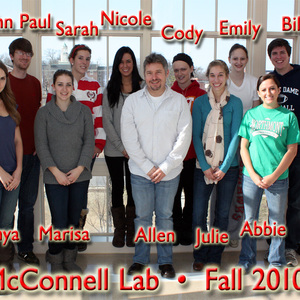
Research Group or Laboratory:
Note from the Network: The holder of this profile has certified having all necessary rights, licenses, and authorization to post the files listed below. Visitors are welcome to copy or use any files for noncommercial or journalistic purposes provided they credit the profile holder and cite this page as the source.
Journal Articles:
- Brown, C. M., & McConnell, A. R. (2011). Discrepancy-based and anticipated emotions in behavioral self-regulation. Emotion, 11, 1091-1095.
- Brown, C. M., & McConnell, A. R. (2009). When chronic isn’t chronic: The moderating role of active self-aspects. Personality and Social Psychology Bulletin, 35, 3-15.
- McConnell, A. R. (2011). The Multiple Self-aspects Framework: Self-concept representation and its implications. Personality and Social Psychology Review, 15, 3-27.
- McConnell, A. R., & Brown, C. M. (2010). Dissonance averted: Self-concept organization moderates the effect of hypocrisy on attitude change. Journal of Experimental Social Psychology, 46, 361-366.
- McConnell, A. R., Brown, C. M., Shoda, T. M., Stayton, L. E., & Martin, C. E. (2011). Friends with benefits: On the positive consequences of pet ownership. Journal of Personality and Social Psychology, 101(6), 1239-1252.
- McConnell, A. R., Dunn, E. W., Austin, S. N., & Rawn, C. D. (2011). Blind spots in the search for happiness: Implicit attitudes and nonverbal leakage predict affective forecasting errors. Journal of Experimental Social Psychology, 47(3), 628-634.
- McConnell, A. R., & Leibold, J. M. (2001). Relations among the Implicit Association Test, discriminatory behavior, and explicit measures of racial attitudes. Journal of Experimental Social Psychology, 37, 435-442.
- McConnell, A. R., Renaud, J. M., Dean, K. K., Green, S. P., Lamoreaux, M. J., Hall, C. E., & Rydell, R. J. (2005). Whose self is it anyway? Self-aspect control moderates the relation between self-complexity and well-being. Journal Experimental Social Psychology, 41, 1-18.
- McConnell, A. R., Rydell, R. J., & Brown, C. M. (2009). On the experience of self-relevant feedback: How self-concept organization influences affective responses and self-evaluations. Journal of Experimental Social Psychology, 45, 695-707.
- McConnell, A. R., Rydell, R. J., & Leibold, J. M. (2002). Expectations of consistency about the self: Consequences for self-concept formation. Journal of Experimental Social Psychology, 38, 569-585.
- McConnell, A. R., Rydell, R. J., Strain, L. M., & Mackie, D. M. (2008). Forming implicit and explicit attitudes toward individuals: Social group association cues. Journal of Personality and Social Psychology, 94, 792-807.
- McConnell, A. R., Sherman, S. J., & Hamilton, D. L. (1997). Target entitativity: Implications for information processing about individual and group targets. Journal of Personality and Social Psychology, 72, 750-762.
- McConnell, A. R., Sherman, S. J., & Hamilton, D. L. (1994). On-line and memory-based aspects of individual and group target judgments. Journal of Personality and Social Psychology, 67, 173-185.
- McConnell, A. R., Shoda, T. M., & Sulborstad, H. M. (2012). The self as a collection of multiple self-aspects: Structure, development, operation, and implications. Social Cognition, 30, 380-395.
- McConnell, A. R., Strain, L. M., Brown, C. M., & Rydell, R. J. (2009). The simple life: On the benefits of low self-complexity. Personality and Social Psychology Bulletin, 35, 823-835.
- Rydell, R. J., & McConnell, A. R. (2006). Understanding implicit and explicit attitude change: A systems of reasoning analysis. Journal of Personality and Social Psychology, 91, 995-1008.
- Rydell, R. J., McConnell, A. R., & Beilock, S. L. (2009). Multiple social identities and stereotype threat: Imbalance, accessibility, and working memory. Journal of Personality and Social Psychology, 96, 949-966.
- Rydell, R. J., McConnell, A. R., & Mackie, D. M. (2008). Consequences of discrepant explicit and implicit attitudes: Cognitive dissonance and increased information processing. Journal of Experimental Social Psychology, 44, 1526-1532.
- Rydell, R. J., McConnell, A. R., Mackie, D. M., & Strain, L. M. (2006). Of two minds: Forming and changing valence-inconsistent implicit and explicit attitudes. Psychological Science, 17, 954-958.
Other Publications:
Courses Taught:
- Attitudes (graduate seminar)
- Intergroup Relations (graduate seminar)
- Introductory Social Psychology
- Judgment and Decision Making
- Nonconscious Social Life
- Perspectives on Stereotyping and Prejudice
- Social Cognition and Social Perception
- Social Psychological Perspectives on the Self
- The Social Psychology of Crises
Allen R. McConnell
Department of Psychology
316 Psychology Building
Miami University
Oxford, Ohio 45056
United States of America
- Phone: (513) 529-2407
- Fax: (513) 529-2420